


News Categories

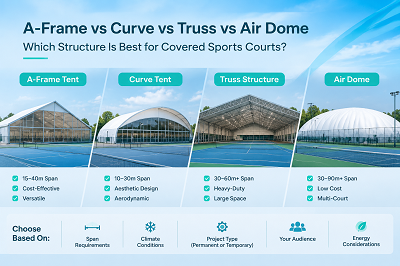
Quick Answer: For covered sports courts, the A-frame (gable) clear-span tent is generally the most cost-efficient choice for 18–40m column-free widths with engineered wind and snow loads. Curve tents are ideal for visually distinctive single-court venues, truss structures suit very large spans of 40m or more, and air domes offer a lower initial structure cost per square meter for multi-court halls. However, air domes require continuous blower power and rely on a membrane-based weather envelope.
Choose according to span, climate and project requirements rather than appearance alone.
Every covered court project starts with the same question: which structure family is the right fit? This guide compares the four options commonly considered by sports facility builders, highlighting the practical trade-offs for tennis, padel, pickleball and basketball facilities.
| Criterion | A-Frame / Gable Tent | Curve / Arc Tent | Truss Structure | Air Dome |
|---|---|---|---|---|
| Efficient Span Range | 15–40m | 10–30m | 30–60m+ | 30–90m+ |
| Cost per m² (Structure) | $$ (baseline) | $$–$$$ | $$$ | $ (large spans) |
| Maximum Interior Height | High at ridge (10m+) | Moderate–high | High | Very high (12m+) |
| Wind Performance | Good, engineered | Very good (aerodynamic) | Good | Requires constant pressure |
| Snow Load Capability | Strong (up to 120+ kg/m²) | Moderate | Strongest | Limited; heating needed |
| Installation Time | 1–3 weeks | 1–2 weeks | 3–6 weeks | 2–4 weeks + inflation |
| Ongoing Energy Needs | None | None | None | Continuous blowers |
| Relocatable / Expandable | Fully modular | Fully modular | Modular, heavier | Modular, heavier |
| Best For | Most sports courts | Showpiece single courts | 40m+ spans, industrial use | Multi-court halls, budget-focused projects |
Note: The comparison is a general project-selection reference. Actual structural capacity, wind and snow performance, installation time and cost depend on engineering design, local conditions and project specifications.
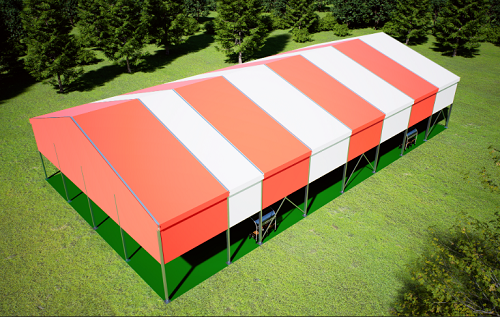
The steep-pitched gable roof is a common configuration for covered sports court projects, including HUANYU TENT's 25×67m padel facility in Phuket and 32×30m basketball gym in Southeast Asia.
Effective rain and snow drainage: The steep roof slope helps shed rainwater and snow, making it suitable for projects in monsoon and northern climates when properly engineered.
Modular expansion: Modular 5m bays allow the structure to extend court-by-court as facility requirements grow.
Flexible end-wall design: Tall gable ends can accommodate glass walls for show courts, subject to project-specific engineering.
Cost efficiency: A strong cost-to-clear-span ratio in the 18–40m range makes this structure suitable for many one-to-four-court projects.
The appearance is relatively utilitarian. For flagship hospitality projects or premium venues where architectural impact is a priority, curve tents or hybrid designs may offer stronger visual appeal.
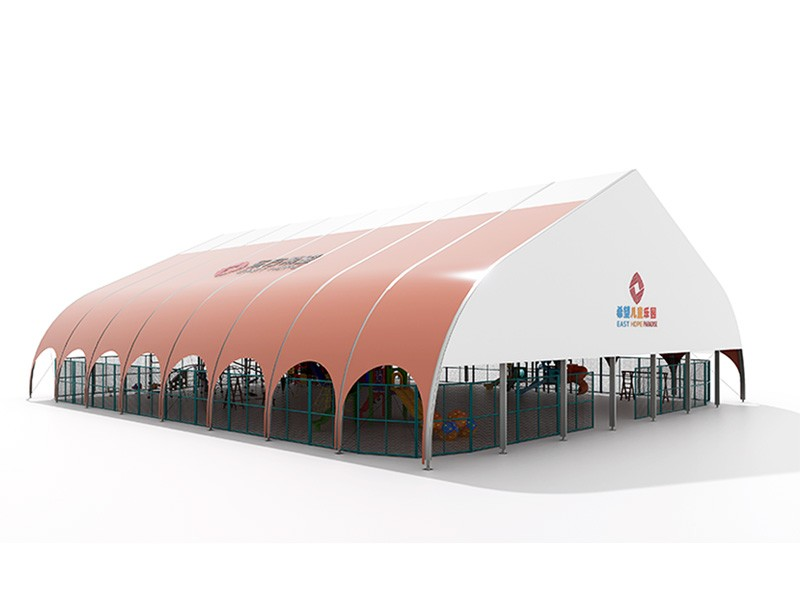
Curve tents feature a continuous arched roofline that sweeps down toward the eaves. TFS-style profiles are among the best-known examples of this structure type.
Aerodynamic profile: The curved shape can provide favorable wind performance when supported by appropriate structural engineering.
Distinctive appearance: The smooth roofline makes curve tents attractive for resorts, flagship sports clubs and beachside venues.
Interior clearance considerations: The curved profile may reduce usable height near the edges. Buyers should check ball clearance for tennis and padel lobs.
Higher structure cost: Cost per square meter may be higher than an A-frame structure at an equivalent span.
Choose a curve tent when the venue is a marketing asset as much as a sports facility. Its visual character can help create a distinctive experience for resorts, premium clubs and demonstration courts.

Steel or reinforced aluminum truss systems are designed to handle large spans and demanding structural loads. They are often considered for large multi-sport halls and sports facilities with industrial-scale requirements.
Large clear spans: Truss structures are suitable for projects requiring 40m+ column-free widths.
Heavy-load engineering: They can be engineered for demanding snow and other environmental loads according to project requirements.
Higher installation demands: Heavier structural components can increase installation time and construction costs.
Potentially excessive for smaller projects: For sports applications below approximately 30m span, a truss structure may be more than the project requires.
Choose a truss structure when the required span exceeds 40m or when the site requires industrial-grade structural load engineering.
Pressurized membrane domes cover large footprints with relatively minimal structural framing. They are often considered for multi-court tennis facilities and large indoor sports halls.
Lower initial structure cost:Air domes can offer a lower structure cost per square meter for large spans of 30m or more.
Continuous blower power: Maintaining internal pressure requires ongoing blower operation. Buyers should account for electricity costs and backup power provisions.
Membrane-based envelope: Insulation and acoustic performance may differ from framed structures with more substantial wall and roof systems.
Snow management: In snowy climates, heating and appropriate snow-management measures may be required to maintain the membrane's performance.
Quote-Ready Fact: Below six courts, frame tents may offer a lower lifetime cost because air domes require continuous blower power. Above six courts, air domes may become more competitive in terms of initial capital expenditure. Actual results depend on energy prices, climate, maintenance and project design.

Choose an air dome when initial capital expenditure is the main constraint, the project requires a large covered area and the site has reliable power infrastructure.
Explore HUANYU TENT's air dome solutions for project-specific options.
What span do you actually need?
For spans under 40m, an A-frame structure is often a practical starting point. For spans over 40m, compare truss structures and air domes according to load requirements, budget and operating conditions.
What does your climate demand?
For heavy snow, consider engineered A-frame or truss solutions. For typhoon-prone and coastal locations, require project-specific wind calculations and appropriate structural design. In hot and dry climates, curve tents may also be worth evaluating.
Is this permanent or transitional?
All four structure types can be designed for relocation in suitable configurations. A-frame and curve tents offer modular bay systems that can support future expansion.
Who is the audience?
For show courts, resorts and premium venues, curve tent aesthetics may justify the additional investment. For training facilities and everyday sports use, A-frame structures are often a practical choice.
What's the energy situation?
If power supply is unreliable, an air dome may not be suitable because continuous blower operation is essential to maintaining internal pressure.
A clear span tent is a structure without interior support columns, allowing the entire floor area to remain usable. All four options compared in this guide can be designed as clear-span solutions. This is particularly important for sports courts, where internal columns would interfere with gameplay and player movement.
An A-frame tent is a practical option for many indoor tennis halls with spans of 18–40m and sufficient ball clearance, such as 8m or more where required by the project. Air domes may also suit facilities with four or more courts and tighter initial capital budgets.
Curve tents can shed moderate snow through their continuous arched profiles. However, for projects with demanding snow loads, A-frame and truss structures may offer more cost-effective engineered solutions. Actual performance depends on structural calculations and local snow conditions.
HUANYU TENT manufactures A-frame, curve, truss, polygon and air dome structures. This allows its team to compare different structure types and recommend a solution based on site conditions and project requirements rather than focusing on a single product category.
Share your court count, site dimensions and project location with HUANYU TENT. Our team can help evaluate suitable structure options, prepare an engineered layout and provide an itemized quotation within one business week, subject to project information and confirmation.
Contact HUANYU TENT to discuss your covered sports court project.
Contact HUANYU TENT
HUANYU TENT is a sports tent manufacturer producing clear-span A-frame, curve, truss and air dome structures for tennis, padel, pickleball, basketball and industrial applications worldwide.


