


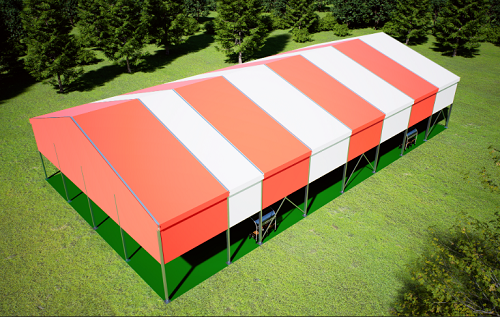
A pickleball sports tent provides a covered space for pickleball courts, helping sports clubs, schools, resorts, and commercial facility operators make better use of outdoor areas. Compared with a permanent sports building, a tent structure can offer flexible layouts, configurable enclosure systems, and a project-specific approach to covered sports facilities.
Before building a pickleball tent, buyers should evaluate court dimensions, total building size, clear-span requirements, frame materials, roof and wall systems, site conditions, and local weather requirements. These factors affect court usability, player comfort, installation planning, and long-term operating costs.
This guide explains what to consider when planning a custom pickleball sports tent and how to evaluate a suitable tent solution for your project.
Key Takeaways
Plan the complete tent dimensions around court layouts, player movement, circulation, and safety clearances.
Choose a suitable clear-span structure to minimize interior obstructions.
Evaluate aluminum frames, roof membranes, sidewalls, ventilation, and enclosure options according to project requirements.
Confirm foundation, anchoring, wind and snow loads, drainage, and local building regulations before installation.
Work with a supplier that can assess custom dimensions, site conditions, and project-specific requirements.
1. What Is a Pickleball Sports Tent?
A pickleball sports tent is a tent-based structure designed to cover one or more pickleball courts. Depending on the project, it may be used as a seasonal sports shelter, a semi-permanent recreational facility, or a larger covered venue for regular training and commercial operations.
Compared with an uncovered outdoor court, a covered structure can provide shelter from direct sunlight and rain when appropriately designed. Sidewalls and enclosure systems can also be configured to address wind exposure, privacy, ventilation, and operating requirements.
Typical applications include:
Sports clubs: Add covered courts for training, recreation, and membership activities.
Schools and universities: Create flexible spaces for physical education and sports programs.
Hotels and resorts: Provide recreational facilities for guests.
Commercial sports centers: Develop covered pickleball facilities for lessons, bookings, and events.
Community facilities: Improve the usability of outdoor recreational areas.
Explore HY Tent's sports court tent solutions to learn more about covered sports structures for different applications.
2. What Size Pickleball Tent Do You Need?
Choosing the right size is one of the most important steps in planning a pickleball tent. The dimensions of the playing court are only the starting point. The overall tent footprint must also accommodate player movement, circulation, access points, and any additional facilities included in the project.
Standard Pickleball Court Dimensions
A standard pickleball court measures 20 feet wide by 44 feet long, including the playing lines. However, this is the playing area rather than the recommended total building size.
Additional space is needed around the court for players to move safely, retrieve balls, and enter or leave the playing area. The appropriate clearance depends on the facility layout, intended use, and applicable sports or building requirements.
| Planning Item | What to Consider |
|---|---|
| Court dimensions | A standard playing court is 20 × 44 ft (approximately 6.1 × 13.4 m). |
| Safety clearance | Allow additional space around the court for player movement and ball retrieval. |
| Number of courts | Consider the arrangement of courts, spacing between them, and shared circulation areas. |
| Interior height | Evaluate usable overhead clearance for lobs, lighting, and other equipment. |
| Additional facilities | Include space for entrances, seating, storage, reception, or spectator areas where needed. |
Single-Court vs. Multi-Court Pickleball Tents
A single-court tent may suit a private facility, school, or small recreational venue. Multi-court structures may be more suitable for sports clubs and commercial operators that need to accommodate more players and scheduled activities.
The final size should be determined from a scaled layout rather than the playing-court dimensions alone. Before requesting a quotation, prepare the target number of courts, available site dimensions, preferred entrances, and any requirements for spectator or support areas.
3. Which Pickleball Tent Structure Is Best for Your Project?
The frame configuration affects the usable interior space, structural design, installation process, and overall appearance of a pickleball sports tent. The most appropriate option depends on the required span, site conditions, project budget, and intended operating period.
| Structure Type | Potential Advantages | Key Considerations |
|---|---|---|
| A-frame tent | Straightforward rectangular layout and flexible sizing options. | Confirm the required span, eave height, ridge height, and frame arrangement. |
| Arcum or curved-roof tent | Curved roof profile and a distinctive appearance for sports facilities. | Assess the usable interior height and court layout against the roof geometry. |
| Large-span sports tent | Can support larger open interior layouts with fewer internal obstructions, subject to engineering design. | Requires project-specific structural calculations, anchoring, and site assessment. |
For pickleball facilities, clear-span space is particularly important because columns or other obstructions can interfere with court arrangements and player movement. Buyers should confirm the proposed clear span and internal clearance in the supplier's drawings before finalizing the design.
Learn more about sports tent options from HY Tent and discuss the structure that best fits your project.
4. How to Choose Materials, Walls, and Weather Protection
The roof covering, frame material, and sidewall configuration all affect how a pickleball tent performs in its intended environment. Material selection should be based on climate, operating hours, ventilation requirements, maintenance expectations, and the applicable structural design.
Frame Materials
Aluminum alloy is commonly used in modular tent structures because of its combination of strength and relatively low weight. The required frame specifications depend on the span, height, enclosure system, local wind and snow conditions, and other project loads.
When comparing suppliers, request the proposed frame specifications and structural documentation instead of evaluating a tent by material name alone.
Roof Membrane and Sidewalls
PVC-coated fabric is one option for tent roof and wall systems. The appropriate membrane specification should reflect the intended application, expected exposure, and required performance characteristics.
Depending on the facility design, possible enclosure options include:
Fully enclosed sidewalls: May help provide greater separation from outdoor conditions when appropriately designed.
Removable or roll-up walls: Can provide flexibility for ventilation and seasonal operation where the system supports these options.
Transparent or windowed sections: May help introduce natural light and improve visibility.
Open-sided configurations: May suit projects where airflow and access are priorities, subject to weather and safety requirements.
Ventilation, Lighting, and Player Comfort
A covered court needs more than a roof. Ventilation, lighting, access, and interior temperature should all be considered during planning. An enclosed tent may require a different ventilation strategy from an open-sided sports shelter.
Lighting positions should minimize glare and shadows across the playing surface. If the facility will operate in hot, cold, humid, or windy conditions, discuss additional environmental controls with the design team before selecting the final configuration.
Important: Weather resistance depends on the complete structure, engineering design, installation, anchoring, and site conditions. Confirm applicable wind and snow loads, drainage, and local code requirements for the specific project.
5. What Can Be Customized in a Pickleball Sports Tent?
A custom pickleball sports tent can be planned around the available site, number of courts, intended usage, and local environmental conditions. Defining these requirements early helps the supplier develop a more practical layout and quotation.
| Customization Area | Details to Confirm |
|---|---|
| Overall dimensions | Required width, length, eave height, ridge height, and clear span. |
| Court layout | Number of courts, spacing, player circulation, entrances, and spectator areas. |
| Frame and roof | Structural configuration, frame specifications, roof profile, and covering material. |
| Wall and access systems | Sidewall type, doors, access routes, ventilation, and window sections. |
| Accessories and facilities | Lighting provisions, drainage considerations, branding, and other agreed options. |
| Site and environmental requirements | Ground conditions, anchoring method, local weather loads, and applicable regulations. |
Customization should be based on the actual site and intended operation rather than simply choosing a standard tent size. A detailed layout and a clear specification list can help reduce design revisions and improve quotation accuracy.
6. What Should You Prepare Before Installing a Pickleball Tent?
Successful installation starts with site assessment and project planning. Before production or installation begins, buyers should coordinate the proposed structure with the site layout, foundation or anchoring design, drainage plan, and local approval process.
Site and Ground Conditions
Check the available footprint, ground slope, drainage, underground utilities, access for delivery vehicles, and any nearby structures. The appropriate foundation or anchoring system depends on the ground conditions and the engineered design.
Weather Loads and Local Regulations
Share the installation location with the supplier so the project team can assess relevant environmental conditions. Wind exposure, snow loads, rainfall, and other local factors may affect the structural design and installation requirements.
Confirm whether permits, engineering documents, inspections, or other approvals are required by local authorities. Do not assume that a tent design approved for one location will automatically meet the requirements of another.
Installation and Operations
Plan delivery access, unloading space, installation equipment, work schedules, and the sequence for installing the court surface and tent structure. If the facility will be used year-round, also consider maintenance access, lighting, ventilation, and emergency exits.
Discuss the expected installation scope with the supplier in advance, including which site preparation, labor, equipment, and commissioning tasks are included in the quotation.
7. How to Choose a Reliable Pickleball Tent Supplier
Choosing a supplier involves more than comparing the initial price. The supplier should understand the intended sports application and be able to discuss the dimensions, structural configuration, materials, site conditions, and documentation needed for the project.
When evaluating a pickleball tent supplier, consider the following points:
Product suitability: Can the supplier propose a structure that fits your required span, height, and court arrangement?
Customization capability: Can dimensions, enclosure options, access points, and other project requirements be reviewed?
Technical documentation: Can the supplier provide relevant drawings, material specifications, and structural documentation for evaluation?
Site-specific planning: Will the supplier consider installation location, weather conditions, anchoring, and applicable regulations?
Quotation transparency: Does the quotation clearly describe the included structure, accessories, delivery scope, and any exclusions?
Project communication: Can the team coordinate design revisions, production details, delivery planning, and installation responsibilities?
For overseas buyers, it is also useful to confirm shipping arrangements, packaging details, expected production lead time, warranty terms, and after-sales support before placing an order.
Providing a complete project brief helps the supplier assess your requirements more efficiently and reduces the risk of comparing quotations that cover different scopes.
8. Example: A 20 × 40 m Pickleball Sports Tent Project
A 20 × 40 m A-frame sports tent is one example of a tent configuration that can be evaluated for a pickleball-related project. The suitability of this footprint depends on the proposed court layout, required clearances, usable interior height, circulation space, and any additional facilities.
Before determining the number of courts, the layout should be checked against the actual playing dimensions and the required clearance around each court. The nominal tent dimensions alone are not enough to establish the final court capacity.
When reviewing a project of this type, confirm:
Whether the proposed footprint accommodates the planned number of courts and safety clearances.
Whether the interior height and clear-span arrangement suit the intended play and lighting requirements.
Whether the frame, roof, walls, and anchoring design match the installation site's conditions.
Whether entrances, player circulation, ventilation, and maintenance access are adequately planned.
View the 20 × 40 m A-frame Pickleball Sports Tent page for a product-specific reference. Final dimensions and court capacity should always be confirmed through the project's drawings and technical review.
9. Frequently Asked Questions About Pickleball Tents
How big should a pickleball sports tent be?
The required size depends on the number of courts, court clearances, circulation, interior height, and any additional facilities. A standard pickleball court is 20 × 44 ft, but the overall tent footprint must be larger to accommodate the complete layout.
Can a pickleball tent accommodate multiple courts?
Yes, a suitably designed sports tent can be planned for multiple courts. The final capacity depends on the overall dimensions, clear-span arrangement, spacing between courts, player circulation, and safety requirements.
What materials are used for pickleball sports tents?
Common configurations may use aluminum alloy frames and PVC-coated fabric roof or wall coverings. The final material specifications should be selected according to structural requirements, local weather conditions, expected use, and the project's budget.
Can I order a custom pickleball sports tent?
Custom options may include overall dimensions, span, height, court layout, roof configuration, sidewalls, entrances, and accessories. Share your project location and requirements with the supplier to determine which options are suitable and available.
Can a pickleball tent be used throughout the year?
Year-round use depends on the structure's engineering, enclosure, ventilation, weather loads, anchoring, and local regulations. Ask the supplier to evaluate the installation site and confirm the design requirements for the intended operating conditions.
What information is needed for a pickleball tent quotation?
Prepare the required tent dimensions, number of courts, installation location, intended application, preferred structure, enclosure requirements, estimated quantity, and project schedule. Site drawings or photographs can also help the supplier evaluate the layout.
10. Get a Custom Pickleball Sports Tent Solution from HY Tent
Planning a covered pickleball court requires coordination between court layout, structural design, material selection, site conditions, and installation requirements. A clear project brief helps identify a suitable configuration and supports a more accurate quotation.
HY Tent provides tent solutions for sports and other commercial applications. If you are planning a new pickleball facility or expanding an existing sports venue, share your project requirements to discuss a suitable configuration.
Planning Your Pickleball Tent Project?
Send us your required dimensions, number of courts, installation location, application, and estimated quantity to start a project discussion.
Discuss Your Custom Tent View Sports Court SolutionsNote: Final tent dimensions, court capacity, materials, structural specifications, and installation methods should be confirmed according to project drawings, site conditions, engineering requirements, and applicable local regulations.


