


News Categories

When purchasing a warehouse storage tent, buyers often focus on span width, length, frame material, fabric specifications, wind resistance, and price. However, another factor can have a major impact on project success: how the tent manufacturer verifies the structure before shipment.
For large warehouse projects, individual components may be manufactured accurately but still create installation difficulties if they are not properly matched as a complete system. Factory trial assembly provides an additional quality-control step by assembling and checking relevant components before the tent is delivered.
For an industrial warehouse tent or frame warehouse tent, this process can help identify component compatibility issues, verify assembly procedures, reduce on-site adjustments, and make installation more predictable.

Trial assembly is the process of assembling a tent structure or its major components at the factory before shipment.
Instead of checking aluminum or steel frame components, connectors, covers, doors, and accessories only as individual parts, the manufacturer verifies how these components work together as a system.
For a warehouse storage tent, a typical trial assembly check may include:
Frame component matching
Connection points and fittings
Roof and wall system compatibility
Structural dimensions
Fasteners and accessories
Door and entrance components
Assembly sequence
Overall component compatibility
The purpose is not necessarily to permanently construct the entire warehouse at the factory. Rather, trial assembly provides an opportunity to verify critical components and installation procedures before the products reach the project site.
An industrial warehouse tent is usually much more demanding than a small temporary shelter. It may need to provide a large usable storage area for inventory, raw materials, machinery, logistics operations, or seasonal goods.
HY Tent's warehouse solutions are designed for industrial storage applications and can be customized according to project requirements. Its warehouse tent solutions include modular structures designed for relatively fast assembly and disassembly, making factory-level verification particularly valuable for larger projects.
A warehouse tent consists of multiple structural and accessory components. Even when each component meets its individual production requirements, the complete system still needs to fit together correctly.
Trial assembly helps manufacturers verify whether:
Frame sections connect correctly
Connectors match the corresponding profiles
Roof and wall components fit the structure
Doors align with their designated positions
Fasteners and accessories are compatible
Identifying these issues at the factory is generally more efficient than discovering them after the shipment has arrived at the customer's site.
Dimensional accuracy is particularly important for a large frame warehouse tent.
The relationship between columns, beams, roof structures, connection points, and covering systems needs to be consistent with the design. A small mismatch between components can become more difficult to manage when many sections are assembled together.
Factory trial assembly provides an additional opportunity to check these relationships before delivery.
A warehouse tent is a modular structure. The installation team needs to know not only whether components fit, but also how they should be assembled.
Trial assembly can help manufacturers verify the practical installation sequence and identify steps that may require additional instructions or attention.
This is particularly useful for overseas projects where the customer may complete installation with its own local team or contractors.
The most important benefit of trial assembly is simple:
Potential installation problems can be identified before the warehouse tent leaves the factory.
Instead of transferring preventable compatibility issues to the construction site, manufacturers can address them during the production and quality-control stage.
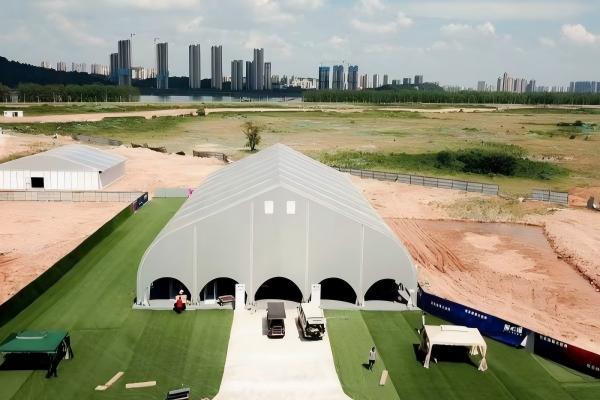
A frame warehouse tent depends on the accurate connection of multiple structural elements.
During installation, workers may need to assemble:
Main frame sections
Roof structures
Sidewall structures
Connection components
Doors and entrances
Covering systems
Additional accessories
If the components have not been adequately verified, installation teams may encounter unexpected adjustments.
Factory trial assembly helps create a more predictable installation process by checking critical connections and component relationships in advance.
The basic process can be summarized as:
Design → Production → Trial Assembly → Inspection → Packing → Shipment → Site Installation
This approach allows the manufacturer to move part of the problem-solving process from the customer's construction site back to the factory.
For overseas buyers, this can be especially valuable because solving a component problem after international delivery may require additional labor, replacement parts, shipping arrangements, and installation time.

A professional trial assembly process should focus on the components that have the greatest influence on installation.
| Check Item | What It Helps Verify |
|---|---|
| Frame Components | Dimensions and component matching |
| Connectors | Connection compatibility |
| Roof Structure | Alignment and assembly sequence |
| Wall System | Compatibility with the main frame |
| Doors | Position and fitting |
| Fasteners | Quantity and compatibility |
| Accessories | Matching with the overall structure |
| Assembly Sequence | Practical installation procedure |
| Overall Structure | General system compatibility |
The exact inspection procedure can vary according to the warehouse tent design, dimensions, frame system, accessories, and project requirements.
The difference between these two approaches is mainly where potential installation problems are discovered.
| Factor | Trial-Assembled Warehouse Tent | Conventional Delivery |
|---|---|---|
| Component Matching | Checked before shipment | May be discovered during installation |
| Installation Preparation | More predictable | Depends more heavily on site conditions |
| On-Site Adjustment | Potentially reduced | May be required |
| Rework Risk | Lower for preventable compatibility issues | Potentially higher |
| Installation Planning | Supported by verified assembly procedures | May require additional site adjustment |
| Delivery Confidence | Higher visibility before shipment | More uncertainty after arrival |
Trial assembly does not eliminate every possible installation challenge. Site conditions, foundations, weather, local labor, lifting equipment, and installation practices can all affect project execution.
However, it can reduce preventable problems related to component compatibility and assembly procedures.
For an overseas warehouse storage tent project, installation delays can have a wider impact than simply adding a few hours of labor.
A component problem discovered on site may require:
Additional measurements
Structural adjustments
Rework
Replacement components
Additional labor
Communication between the buyer and manufacturer
Additional transportation or shipping
By verifying critical components before shipment, manufacturers can reduce the likelihood of these preventable problems.
The goal is not simply to make the factory process more complicated. The goal is to make the customer's installation process more predictable.
For international buyers, selecting a warehouse tent manufacturer involves more than comparing product prices.
A supplier should also be evaluated according to its ability to control the manufacturing and delivery process.
Before ordering an industrial warehouse tent, buyers can ask the manufacturer:
This helps determine whether the supplier verifies the actual compatibility of critical components before shipment.
Dimensional control is particularly important for large modular structures.
Doors, connectors, fasteners, and other accessories can affect the installation process.
Clear installation documentation can help overseas teams understand the assembly sequence.
Visual evidence can give buyers a better understanding of how the manufacturer verifies its products.
A clear corrective process is an important part of manufacturing quality control.
A reliable manufacturer should provide more than a warehouse tent structure.
For B2B projects, buyers should consider the complete supply chain:
Design → Engineering → Material Selection → Production → Quality Control → Trial Assembly → Packing → Delivery → Installation Support
This is particularly important for customized projects where the dimensions, frame configuration, entrances, walls, doors, and other components may vary from one project to another.
HY Tent has more than a decade of experience in tent manufacturing and provides customized tent solutions for different applications. The company offers warehouse tent solutions for various industrial and storage requirements.
HY Tent provides modular warehouse solutions for temporary and longer-term industrial storage requirements. Its warehouse tent range includes different structural configurations and customized sizes for applications such as storage, logistics, industrial operations, and other large-space requirements.
For example, HY Tent's A-Frame Truss Warehouse Tent uses a triangular truss structure designed for structural stability and modular assembly. Its warehouse solutions can also be customized according to project dimensions and application requirements.
The company has also completed warehouse storage projects for industrial customers, including a crusher storage tent in Beijing. The project used a modular aluminum-frame structure designed for industrial storage and emphasized quick assembly, transportation, customization, and reuse.
For customized projects, factory verification and trial assembly can become an important part of ensuring that the delivered components are prepared for the intended installation process.
Trial assembly can be particularly valuable when:
The warehouse tent is large or highly customized
The structure has complex frame configurations
The project requires multiple accessories
Installation will be performed by a local overseas team
The project has strict installation deadlines
Replacement components would be difficult or expensive to ship
The tent will be used for important industrial or logistics operations
For standard, small-scale structures, the extent of factory trial assembly may be different. The appropriate verification process should depend on the project's size, design, structural system, and installation requirements.
Warehouse tent trial assembly is a factory verification process in which major structural components and related accessories are assembled or checked together before shipment to verify compatibility, dimensions, connections, and installation procedures.
It can help identify preventable component-matching and assembly issues before delivery, potentially reducing on-site adjustment, rework, and installation delays.
Trial assembly does not guarantee a specific installation time, but it can make the installation process more predictable by verifying critical components and assembly procedures before shipment.
Typical checks can include frame dimensions, connection points, structural component matching, roof and wall interfaces, doors, fasteners, accessories, and assembly sequence.
Not necessarily. The appropriate level of trial assembly depends on the tent's size, customization level, structural complexity, accessories, and project requirements. Larger or highly customized projects generally benefit more from additional factory verification.
Ask about factory quality control, trial assembly, frame dimensional verification, component matching, installation documentation, customization capability, and technical support.
A successful warehouse storage tent project begins long before the structure arrives at the customer's site.
For an industrial warehouse tent or frame warehouse tent, factory trial assembly provides an additional opportunity to verify component compatibility, structural connections, dimensions, and installation procedures before shipment.
The principle is straightforward:
The earlier a potential installation problem is identified, the easier it is to address.
For overseas warehouse projects, choosing a manufacturer with a systematic approach to design, production, quality control, trial assembly, delivery, and installation support can help reduce unnecessary uncertainty and create a smoother project experience.
If you are planning a customized warehouse storage tent, industrial warehouse tent, or frame warehouse tent, HY Tent can provide project-based tent solutions based on your required dimensions, application, structure, and site conditions.


