


News Categories

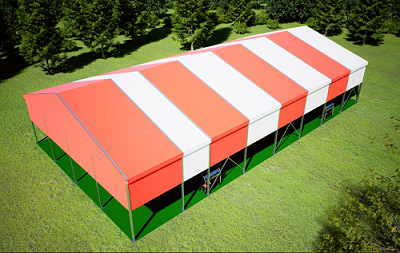
Quick answer: A single-court pickleball tent typically costs $30,000–70,000 FOB from a Chinese manufacturer, depending on span, engineering loads and wall configuration. Four-court venues usually land between $120,000–260,000, and 6–8 court tournament facilities from $200,000–450,000. Add roughly 25–40% on top for freight, foundations and installation. The biggest cost driver is never the court itself — it is the span you choose and the wind or snow loads your site must be engineered for.
Pickleball is the fastest-growing sport in North America, and the single most common question from operators, municipalities and private owners is what a covered venue actually costs. This guide breaks down real budget ranges for pickleball court tents, the seven factors that move the price, and where buyers routinely overpay. Figures reflect 2026 FOB pricing from established Chinese manufacturers for engineered aluminum-frame structures.
| Facility Size | Typical Tent Footprint | FOB Price Range (2026) | Notes |
|---|---|---|---|
| 1 court | 12 × 24 m (~288 m²) | $30,000–70,000 | Private estates, backyard clubs |
| 2 courts | 20 × 24 m (~480 m²) | $55,000–110,000 | Most popular club configuration |
| 4 courts (2×2) | 20 × 44 m (~880 m²) | $120,000–260,000 | Standard commercial venue |
| 6–8 courts | 40 × 44 m to 40 × 64 m | $200,000–450,000 | Tournament-scale; span above 30m raises per-m² cost |
Budget rule of thumb: Plan $300–700 per square meter of covered area for the structure itself, FOB, before freight and site works.
These ranges assume a clear-span aluminum frame with PVC membrane roof, engineered wind rating, and standard wall packages. Glass show-court walls, full HVAC and heavy snow engineering push toward the top of each band.
Padel and pickleball courts stack efficiently side by side, but every additional meter of span requires heavier aluminum profiles. Cost per m² rises in visible steps at roughly 30m and 40m span. Adding length is almost always cheaper than adding width.
A coastal Florida site and a Colorado mountain site buy very different structures. Certified wind-load calculations (100–130+ km/h) and 75–120 kg/m² snow packages change profiles, purlin density and anchoring — typically 10–25% of structure price.
Open mesh sides are the budget baseline. Solid PVC, transparent window bands and glass show-court walls each add cost — glass most of all, often $80–150 per m² of wall area.
Six meters of clearance is the pickleball minimum; every extra meter of eave height adds frame and membrane area. Spec 7–8m only where the business case justifies it.
850–950 g/m² UV-stabilized blockout PVC is the commercial standard. Cheaper 750 g fabric fails visibly within a few equatorial seasons — the most common "saved $8k, lost $40k" mistake.
LED court lighting rigs, HVAC-ready beams, insulation liners and back-of-house sandwich-panel rooms are optional modules; budget them per project rather than per m².
Sea freight, customs, foundation works and local labor typically add 25–40% on top of FOB for North American and European destinations.
Quote-ready fact: For a covered pickleball venue, the structure usually represents 30–50% of total project capex — the rest is courts, surfacing, lighting, fencing, site works and soft costs.
Buyers comparing "indoor pickleball court cost" figures online often mix structure prices with all-in project costs. For honest planning:
| Line Item | Typical Share of Total Project |
|---|---|
| Tent structure (FOB) | 30–50% |
| Foundations & site works | 8–15% |
| Court surfacing (sport tiles/acrylic) | 10–20% |
| Lighting, electrical, HVAC | 10–15% |
| Freight, customs, installation | 15–25% |
| Design, permits, contingency | 5–10% |
A practical all-in planning range for a four-court covered venue is $350,000–700,000 depending on region and finish level — with the tent itself being the line item where supplier choice moves the number the most.
Over-spanning. A 25m span for two pickleball courts is overkill; 20m is the efficient engineering answer. Over-spanning can inflate structure cost 20–30% for zero playing benefit.
Under-specifying climate loads. The cheapest quote is usually the one that ignores site wind data. Non-engineered structures fail inspections and void insurance — insist on stamped calculations.
Mixed 850g/750g membranes. Ask for grammage certificates per batch, not catalogue claims.
Ignoring membrane lifespan economics. A structure you will run for 15 years should be quoted with membrane replacement costs on the table from day one.
Quote-ready fact: Ask every supplier the same five questions: span engineering basis, membrane grammage with certificates, wind/snow load documentation, installation scope, and warranty terms in writing.
Covered pickleball courts command premium rates precisely because they play through rain, heat and shoulder seasons. Operators in rainy or hot climates typically report 25–40% more bookable hours per year under cover — which is why nearly all new commercial facilities now budget coverage from day one rather than as a later add-on.
A single-span frame tent with open mesh sides and a standard PVC roof — roughly $30,000–50,000 FOB for one court. Prioritize engineering over aesthetics; walls and glass can be added later.
$120,000–260,000 FOB for a 20×44m tent structure; all-in project costs of $350,000–700,000 including courts, lighting and site works.
FOB pricing does not. Most owners choose supervised installation with local labor (cheapest) or a turnkey crew; budget 15–25% of structure cost for either.
For 1–4 courts, frame tents usually win on lifetime cost because air domes need continuous blower power. Above 6 courts, air domes become competitive on capex.
Aluminum frames 15–20 years; membranes 8–12 years with replacement service available.
Send HUANYU TENT your site dimensions, location and court count — you'll receive an engineered layout, specification and an itemized quote within one business week.
Contact HUANYU TENTHUANYU TENT is a pickleball court tent manufacturer providing custom clear-span sports structures for pickleball, padel, tennis, basketball and industrial applications, with CE/SGS certified manufacturing and worldwide OEM/ODM project delivery.


