


News Categories

For a modular tent structure, aluminum frame accuracy is more than a manufacturing detail. The dimensions of every structural component can affect how roof beams, upright columns, connectors, and other frame members fit together during installation.
For tent manufacturers, precision aluminum profile cutting, standardized processing, dimensional inspection, and quality control are therefore important parts of producing reliable tent structures.
This is particularly important for large-span sports tents, warehouse tents, event tents, exhibition tents, and other customized structures where the frame may cover a large clear-span area and require repeated modular assembly.
HY Tent uses extruded 6061/T6 aluminum alloy for its main tent frames and provides customized tent structures for different applications. Its product range includes sports court tents, event tents, warehouse tents, exhibition tents, large-span tents, and other modular structures.

Professional custom tent manufacturers generally control aluminum frame accuracy through several stages:
Confirm structural drawings and dimensions
Select suitable aluminum profiles
Cut profiles according to specified dimensions
Inspect processed components
Standardize connectors and frame components
Perform quality checks before shipment
Use engineering testing and structural verification where required
Provide installation drawings and technical documentation
The purpose is to make sure that aluminum frame components can be assembled consistently and efficiently at the project site.
For customized or large-span tent structures, dimensional consistency becomes particularly important because the structure may contain many repeated components and connection points.
An aluminum tent frame consists of multiple structural components working together as a modular system.
Depending on the design, these can include:
Upright columns
Roof beams
Eave beams
Ridge components
Cross members
Connectors
Bracing components
Base plates
Other structural accessories
If individual components do not match the specified dimensions, installers may need additional adjustment during assembly.
The first benefit of accurate aluminum profile processing is proper component fit.
Roof beams and upright columns need to connect with the corresponding structural components according to the engineering design. Consistent dimensions help reduce unnecessary adjustment during assembly.
Many modern tent structures use modular designs.
HY Tent provides modular structures that can be assembled, dismantled, transported, expanded, or customized according to project requirements.
This means components need to be manufactured consistently so that repeated modules can work together.
When structural components are processed according to standardized dimensions, installers can spend less time correcting dimensional mismatches on site.
For projects where rapid installation is important, this can contribute to a more predictable installation process.
A reliable tent structure manufacturer does not depend on cutting accuracy alone.
Instead, aluminum frame quality should be controlled through a series of connected manufacturing steps.
Before aluminum profiles are processed, the manufacturer needs to establish the structural requirements.
These may include:
Tent span
Tent length
Eave height
Roof configuration
Bay spacing
Ground conditions
Application
Local environmental conditions
Required loading conditions
Connection design
HY Tent offers customized tent structures and can develop and manufacture products according to drawings and samples.
For customized projects, accurate design information provides the basis for subsequent component processing.
The next step is selecting the appropriate aluminum profile for the structural application.
HY Tent's product information specifies 6061/T6 aluminum alloy as the primary material used for its aluminum tent frames. Its product range includes structures with different clear-span widths depending on the tent design and application.
6061-T6 aluminum is commonly selected for tent structures because it provides a useful combination of:
Strength
Relatively low weight
Corrosion resistance
Processability
Suitability for modular structures
For sports tent applications, HY Tent uses high-impact extruded anodized 6061/T6 aluminum for its main framework.
Once the profile and dimensions have been confirmed, aluminum profiles are processed into the required structural components.
This is where precision cutting becomes important.
The objective is not simply to cut an aluminum profile into shorter pieces. The components need to correspond to the dimensions and structural requirements defined by the project.
Depending on the design, manufacturers may need to control:
Component length
Cutting consistency
End condition
Quantity
Component identification
Connection-related processing
Consistent cutting helps create interchangeable components for modular tent structures.
Consider a tent structure containing dozens or hundreds of repeated aluminum components.
If the dimensions vary significantly from one component to another, installers may experience:
Difficult connections
Misalignment
Additional adjustment
Longer installation time
Component replacement
Increased project complexity
For this reason, precision cutting should be considered part of the overall tent frame manufacturing process, rather than an isolated production step.
After aluminum profiles are processed, manufacturers should inspect the components before they move to the next production stage.
Typical quality-control considerations may include:
Check whether the processed component corresponds to the required dimensions.
Check the aluminum profile for visible damage or processing defects.
Inspect the cut ends and processed areas to ensure they are suitable for subsequent assembly.
Make sure the correct quantity of each component has been prepared.
For complex customized structures, identification and organization of components can make transportation and installation more efficient.
This becomes particularly useful for large projects where many different frame members need to be installed according to engineering drawings.
Aluminum frame accuracy is not only about profile length.
Connection accuracy is equally important.
A tent structure may contain:
Aluminum profiles
Connectors
Bolts
Brackets
Base plates
Roof components
Structural reinforcement
These parts need to work together as an integrated system.
Therefore, a professional aluminum tent manufacturer should evaluate the complete frame system rather than focusing on a single aluminum profile.
This is especially important for large-span structures, where the number of connection points can increase significantly.
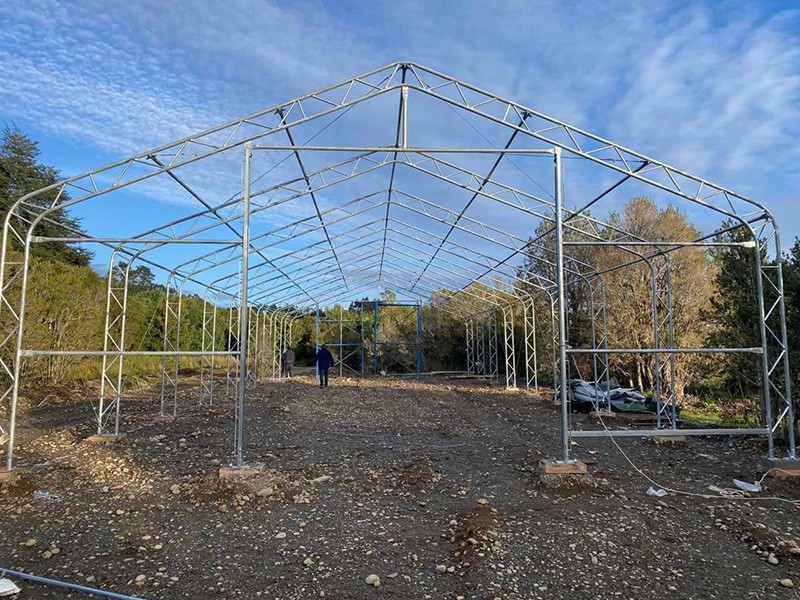
Large-span tent structures place greater demands on manufacturing consistency.
HY Tent provides tent structures with different clear-span widths, including large-span sports and exhibition structures. Its project portfolio also demonstrates experience with large customized structures for international markets.
As the span increases, the structure may involve more:
Structural components
Connection points
Repeated modules
Roof beams
Supporting members
Installation steps
Therefore, maintaining component consistency becomes increasingly important.
Sports court tents
Sports halls
Exhibition tents
Event tents
Warehouse tents
Industrial storage tents
Aviation hangar tents
Large temporary venues
HY Tent provides solutions for sports, warehouse/workshop, event, exhibition, Hajj, aviation hangar, and other applications.
Poor dimensional consistency does not necessarily mean that a complete tent structure will fail, because structural performance also depends on engineering design, materials, connections, anchoring, installation, and environmental loads.
However, inaccurate components can create avoidable manufacturing and installation problems.
Components may require additional adjustment before they can be connected.
Dimensional differences can make it more difficult to maintain the intended alignment between structural members.
Installers may need additional time to identify and correct mismatched components.
If a component cannot be adjusted or used as intended, it may need to be replaced.
For international projects, correcting component problems after shipment can be considerably more difficult than identifying them during factory quality control.
This is why manufacturing quality control is especially valuable for exported modular tent structures.
The relationship can be summarized as:
Accurate Design
↓
Correct Aluminum Profile Selection
↓
Precision Cutting
↓
Component Inspection
↓
Consistent Connections
↓
Efficient Modular Assembly
↓
Reliable Tent Structure
This manufacturing chain is particularly relevant to B2B buyers purchasing customized tent structures from overseas manufacturers.
A buyer is not simply purchasing fabric and aluminum profiles. They are purchasing a complete structural system that needs to be transported, assembled, operated, dismantled, and potentially reused.
For many aluminum-frame tent systems, aluminum alloy is selected because it offers a balance between structural performance and weight.
HY Tent's published product information specifies 6061/T6 aluminum alloy for its main aluminum tent frameworks.
The material can be used for major components such as:
Upright supports
Roof beams
Main frame profiles
Structural members
Modular frame components
HY Tent's product range includes both aluminum and steel structural options depending on the application. Therefore, material selection should be based on the project's structural requirements rather than assuming that one frame material is suitable for every application.
HY Tent positions itself as a customized tent manufacturer providing one-stop tent solutions for different applications.
According to its website, the company has more than a decade of tent manufacturing experience, provides customized products, and has an R&D team capable of developing products according to drawings and samples. The company also lists CE and SGS certifications and technical patents.
Its product information identifies several quality-related characteristics:
6061/T6 aluminum alloy frame
Modular structural design
Customized dimensions
Engineering testing
Structural quality control
Professional technical documentation
International project experience
For sports tent applications, HY Tent states that its products have undergone engineering tests and that its main framework uses 6061/T6 anodized aluminum.
For certain customized projects, the company can also provide structural drawings, packing lists, installation manuals, and relevant certificates.
When evaluating a tent structure manufacturer, buyers should look beyond the appearance of the finished tent.
Consider asking the following questions:
Ask for the material specification rather than simply asking whether the frame is aluminum.
Find out whether the manufacturer has standardized processing and quality-control procedures.
A professional manufacturer should have a clear inspection process.
This is particularly important for modular and large-span tent systems.
Engineering documentation can help buyers understand the proposed structure and installation requirements.
Ask whether span, length, height, roof shape, layout, and other structural requirements can be customized.
Structural requirements should be evaluated according to the project location and expected environmental conditions.
For international projects, installation manuals and technical support can be valuable.
It is important to understand that precision aluminum profile cutting does not independently determine the safety or performance of a tent structure.
A reliable tent structure depends on the complete system, including:
Structural engineering
Aluminum profile specifications
Component dimensions
Connections
Anchoring
PVC fabric
Wind and snow conditions
Ground conditions
Installation quality
Maintenance
HY Tent's product information describes its PVC covers as flame-retardant, waterproof, UV-resistant and mould-resistant, while its aluminum frames are based on 6061/T6 alloy.
Therefore, buyers should evaluate the complete tent system, not just the aluminum frame.
Tent manufacturers can control frame accuracy through engineering drawings, standardized aluminum profiles, precision cutting, dimensional inspection, component identification, connection checks, and final quality control before shipment.
Precision cutting helps structural components match their specified dimensions, which can support better connections, alignment, modular assembly, and installation efficiency.
HY Tent's published product information specifies 6061/T6 aluminum alloy for its main aluminum tent frameworks.
Yes. HY Tent provides customized tent solutions and can develop products according to customer drawings and samples. Its product range also supports customized options for size, shape, and application.
Aluminum tent structures can be used for sports facilities, events, exhibitions, warehouses, workshops, industrial storage, aviation hangars, weddings, and other temporary or semi-permanent applications.
HY Tent provides different clear-span tent structures, with available span widths depending on the structure, engineering requirements, and application.
Many modular tent systems are designed for assembly and disassembly, allowing structures to be relocated or reused when the engineering design and operating conditions permit. HY Tent describes several of its modular tent systems as reusable.
For a professional tent manufacturer, aluminum frame accuracy is part of a much larger quality-control system.
The process begins with correct engineering dimensions, continues through appropriate material selection and precision aluminum profile cutting, and extends to component inspection, connection control, documentation, and installation support.
For buyers of custom aluminum tent structures, evaluating these manufacturing capabilities can help distinguish between a supplier that simply sells tent components and a manufacturer capable of delivering a complete, engineered modular tent solution.
With 6061/T6 aluminum frame systems, customized structural designs, modular tent solutions, engineering testing, and experience across sports, warehouse, event, exhibition and other applications, HY Tent can provide customized tent structures based on project requirements.
Looking for a custom aluminum tent structure?
Share your required span, length, height, application, location and expected installation conditions with HY Tent to discuss a suitable structural solution.


